
You intend to do the task. You remember that it matters. Yet when a chance to begin appears, you answer another message, tidy something, or decide you will be better prepared tomorrow.
Why does this particular task keep getting pushed aside? The answer is not always the same. You might be unsure where to start, worried about getting it wrong, or facing a workload that leaves little room for it. A strategy that addresses one of those problems may do little for another.
Before choosing a productivity technique, look at what is getting in the way. That does not mean finding an excuse or reaching a verdict about your character. It means understanding the situation well enough to choose a useful response.
This article explores several possible reasons for procrastination, then offers a short self-check to help you examine one delayed task. The goal is not to explain every instance of delay. It is to help you move from “Why can’t I just do this?” to a more practical question: “What would make the next step possible?”
PROCRASTINATION IS A PATTERN TO UNDERSTAND, NOT A CHARACTER FLAW
In everyday terms, procrastination means putting off something you intend to do, often while recognizing that you would rather have made progress. But not every delay fits that description. Choosing to handle an urgent responsibility before a less important task can be sensible prioritization. Moving work to another day because essential information is missing can be a reasonable decision.
A useful distinction is whether you have made a considered choice about the task or are repeatedly leaving it unresolved. “I will review this tomorrow morning after the figures arrive” is different from “I’ll deal with it later,” repeated without a plan.
Even then, delay describes what happened—not why. The same person might postpone paperwork because the instructions are confusing, avoid a difficult conversation because it feels uncomfortable, and leave household maintenance undone because their available time is already committed.
Calling yourself lazy does not distinguish between those situations or tell you what to change. Looking closely at the task can. The reasons below are possibilities to consider, not a complete list or a diagnostic checklist. More than one may apply, and your first explanation may need revising.
COMMON REASONS PEOPLE PUT TASKS OFF
To make the differences concrete, imagine a hypothetical task: preparing a short project update for your team. The task stays the same throughout the examples, but the obstacle changes. That matters because each obstacle calls for a different response.
THE TASK IS UNCLEAR
“Work on the project update” sounds like a task, but it leaves several questions unanswered. Who will read it? What information do they need? Is it an email, a document, or a presentation? What would count as finished?
If you cannot picture the action you need to take, sitting down to work may turn into repeatedly checking instructions or opening and closing files. What looks like reluctance may partly be a lack of direction. You are trying to begin while still deciding what the task actually involves.
In the hypothetical example, you might have plenty to report but no clear understanding of the expected format. The missing piece is not necessarily more effort. It may be one clarification about the audience or the required content. If those details are clear and starting still feels difficult, the size of the task may be a better place to look.
THE TASK FEELS TOO LARGE OR COMPLEX
A short label can hide a lot of work. “Prepare the update” might mean gathering information from several people, checking progress against a plan, deciding which details matter, drafting the message, and reviewing it for accuracy.
Even when you understand the outcome, you may struggle to see a manageable starting point. Some steps depend on other steps. Several decisions compete for attention. Instead of approaching one piece, you keep confronting the whole unfinished project.
This differs from simple ambiguity: you may know what needs to happen but have trouble organizing it into something you can approach. Breaking work down can help, but only if the smaller steps are concrete. Replacing “prepare the update” with “do the preparation” leaves much of the same problem intact. A useful breakdown makes the work easier to act on, not merely longer to describe.
STARTING BRINGS UP DISCOMFORT OR UNCERTAINTY
Sometimes the difficulty is less about the task’s structure and more about how it feels. A task might seem boring, frustrating, awkward, or uncertain. Opening it may bring you into contact with something you would rather not deal with yet.
For example, imagine that the project update needs to explain a missed milestone. You might avoid the document because writing it means confronting an uncomfortable situation. Switching to an easier task offers some immediate distance from that feeling, even though the update remains unfinished.
That is one possible explanation, not a universal rule. Feeling frustrated does not prove that frustration caused the delay. Still, noticing the feeling gives you useful information. “I expect this to be awkward” points toward a different next step than “I don’t know where the project notes are.”
FEAR OF MISTAKES OR EVALUATION GETS IN THE WAY
You may know exactly what to do and still hesitate because the result will be judged. Perhaps you worry about overlooking a detail, sounding inexperienced, or producing work that falls below your own expectations.
In the project-update example, you might repeatedly rewrite the opening sentence rather than draft the main points. Or the document may already be complete, but you keep postponing the moment of sharing it. These are different points of hesitation: starting the work, accepting an imperfect draft, and letting someone else see it.
The distinction matters. If every sentence feels as though it must be ready for immediate publication, even a rough beginning can feel risky. That does not mean you need a label such as “perfectionist.” It means the standard you are applying at this stage may be making the task harder to approach than it needs to be.
COMPETING DEMANDS AND PRACTICAL CONSTRAINTS MAKE THE TASK HARD TO APPROACH
Sometimes the practical explanation deserves more attention. Your day may already be full. Interruptions may leave only scattered minutes. You may lack the necessary information, access to a tool, or enough energy for demanding work at the time you planned to do it.
If the project update requires figures that have not arrived, you cannot accurately complete that part by trying harder. If you have scheduled it between back-to-back responsibilities, the available time may not match the work involved. Those are planning or resource problems, not automatically examples of avoidant delay.
Ask whether the task is realistically possible under the current conditions, and whether any useful part is possible now. You might be unable to finish the update but able to request the missing figures.
These barriers can also overlap. A crowded schedule can make an unclear task harder to begin because there is little room to work out the details. Concern about mistakes may make a complex task feel even larger. You do not have to isolate one perfect explanation before making an adjustment.
A SHORT SELF-CHECK FOR ONE SPECIFIC TASK
Instead of examining your entire approach to productivity, choose one task you are currently delaying. Keep it specific: “Draft the project update” gives you more to work with than “Get organized.” Then consider these questions.
- What exactly am I putting off? Identify the point of delay. Is it gathering information, writing the first paragraph, checking the work, or pressing send? Different stages may have different barriers.
- What happens when I try to begin? Describe what you do, think, or feel. Perhaps you search for instructions, switch to messages, feel embarrassed about unfinished work, or realize you lack a needed file. Use observations rather than judgments.
- What about the task is difficult to approach? Consider whether the next action is unclear, the work has too many parts, or starting brings up discomfort or concern about mistakes.
- What practical conditions are affecting it? Look at time, energy, competing priorities, interruptions, and resources. Ask whether your plan assumes capacity you do not currently have.
- What change would make the next step clearer, smaller, less intimidating, or more realistic? Choose a change you can test rather than a demand to “be more disciplined.”
You might notice several answers. Perhaps you are concerned about criticism and also missing information. Choose the barrier that seems most useful to address first, especially if resolving it would make the rest easier.
You do not need certainty. Look for enough evidence to make a reasonable first choice. If you cannot explain what the update should contain, clarification is worth trying. If you can describe the next action but keep rewriting it before moving on, your first-pass standard may deserve attention. Treat the next action as a test of your explanation, not a test of your worth.
MATCH THE NEXT STEP TO THE OBSTACLE
Once you have a working explanation, choose a response that addresses it directly. These options are experiments, not guaranteed fixes. Their value lies in helping you discover what makes this task more workable.
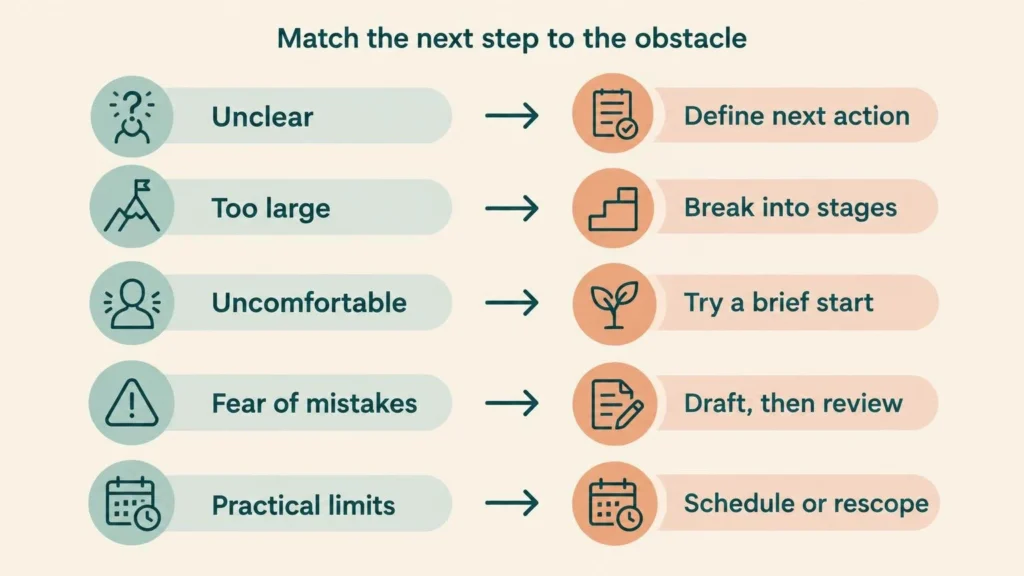
IF THE TASK IS UNCLEAR, DEFINE THE NEXT VISIBLE ACTION
Replace the broad task label with an action you could observe yourself doing. Instead of “work on the update,” try “open last week’s notes and list the information this update needs.” If you cannot take that step without clarification, the next action might be asking the intended reader what decisions the update should support.
Also define what “done for now” means. For an initial planning session, completion might mean having three headings and a list of missing information—not a finished document. A workable endpoint helps distinguish the current step from everything that will eventually follow.
This approach fits when you are spending more effort interpreting the assignment than carrying it out. The aim is to remove uncertainty about the action, not plan every detail in advance.
IF THE TASK FEELS OVERWHELMING, BREAK IT INTO MANAGEABLE STAGES
Separate the work into a few meaningful stages. For the update, those could be gathering information, drafting the main points, and reviewing the result. Then select one stage and make its opening action concrete: “Find the latest milestone dates in the project notes.”
You do not need an elaborate project plan for every small task. The useful level of detail is the one that gives you a starting point without creating another large planning exercise. If a step still feels difficult to approach, ask what it contains and divide that part further.
Choose something small enough to begin but relevant enough to move the task forward. Adjusting fonts may be easy, for example, but it will not resolve missing content. A manageable step should reduce the actual work remaining.
IF DISCOMFORT IS THE MAIN BARRIER, TRY A BRIEF, LOW-PRESSURE START
First, acknowledge the feeling in plain language: “I’m reluctant to write this because explaining the delay feels awkward.” You do not need to argue yourself out of the feeling before testing a small action.
Try a limited starting window—for example, five minutes to open the document and write rough notes about what happened. Decide in advance what you will attempt and allow yourself to reassess when that window ends. The point is not to disguise a demand to finish everything as a tiny commitment.
Discomfort may remain. The useful question is whether you can make a manageable beginning while it is present. If the attempt reveals a different obstacle, such as uncertainty about how to describe the problem accurately, use that information to adjust your approach.
IF FEAR OF MISTAKES IS HOLDING YOU BACK, SEPARATE DRAFTING FROM REVIEWING
Give the first pass a specific, reasonable job. For the update, that might be: capture the main points, mark uncertain details, and leave the wording rough. Accuracy checks and decisions about what to share belong in the review stage.
This does not mean lowering necessary standards for the final result. It means not asking an early draft to meet every final requirement. You can put a placeholder beside a figure that needs checking rather than stopping all progress until you have confirmed it.
When the work is ready but sharing feels difficult, define a review endpoint too. That might involve checking the required facts, confirming that the message answers the request, and using any review process the task requires. The appropriate checks depend on the stakes; separating stages is not a reason to skip safeguards.
IF PRACTICAL CONSTRAINTS DOMINATE, MAKE A DELIBERATE PRIORITY DECISION
Check what the task requires against what is available. How urgent is it? What information or tools are missing? Which existing commitment would have to move to create time? A realistic plan needs to account for those trade-offs.
One option is to schedule a credible return point, with the conditions needed to work. “After the figures arrive on Thursday, I will use the open half-hour before lunch to draft the update” is more actionable than “later this week.” Where possible, request missing resources before that point.
Another option is to reduce the scope if a smaller version meets the need. A brief status email may be sufficient instead of a polished presentation, provided the recipient agrees. If the deadline or requirements cannot be met, communicating that constraint may be the next useful action. Deliberate prioritization sometimes means renegotiating work, not squeezing it into an already full day.
IF THE SAME PATTERN KEEPS RETURNING
If the task repeatedly stalls, review the setup rather than simply repeating the same instruction with more force. Is the work still poorly defined? Does your expected standard exceed what is needed? Are you consistently planning more than your available time allows? Is essential support missing?
Notice whether the pattern belongs to this particular task or appears across many situations. Keeping a brief note of the task, the obstacle you suspected, and what happened after an adjustment may help you see what needs changing. You are looking for useful distinctions, not building a case against yourself.
Persistent or wide-ranging difficulties can have multiple contributing factors. If they are causing significant distress or interfering with daily responsibilities, consider seeking support from an appropriate qualified professional. A productivity strategy can be worth testing, but it cannot diagnose the cause of a difficulty or replace professional support when that is needed.
CHOOSE ONE SMALL, RELEVANT NEXT STEP
The most useful response to procrastination depends on what is getting in the way of this particular task. More pressure will not clarify missing instructions, create unavailable time, or tell you what standard a first draft needs to meet.
Choose one delayed task today. Name the likeliest obstacle, then take one small action that addresses it: clarify a requirement, draft a rough paragraph, request missing information, or make a realistic scheduling decision.
Use the result as information. If the action helps, continue. If it does not, reconsider the obstacle and adjust. You do not need a final explanation of yourself to make a better next move.