

You meant to deal with it yesterday. An email, a form, a report—something that needed your attention but never quite made it to the top of the list. Setting it aside felt reasonable, perhaps even relieving. Now it is back in front of you, and starting feels harder than it did before.
That experience does not, by itself, mean you are lazy or incapable. For some people, repeated delay follows a recognizable pattern: a task feels uncomfortable, switching away offers temporary relief, and the unfinished task returns with added pressure or uncertainty. The next time you encounter it, avoiding it may seem appealing again.
This is one useful way to understand procrastination, not an explanation for every postponed task. Sometimes you lack time, information, energy, or someone else’s input. The goal is to find out what is happening in your situation.
By looking closely at the moment you pull away, you can choose a more workable next step—without turning the delay into a judgment about yourself.
HOW A TASK CAN TURN INTO A REPEATING CYCLE
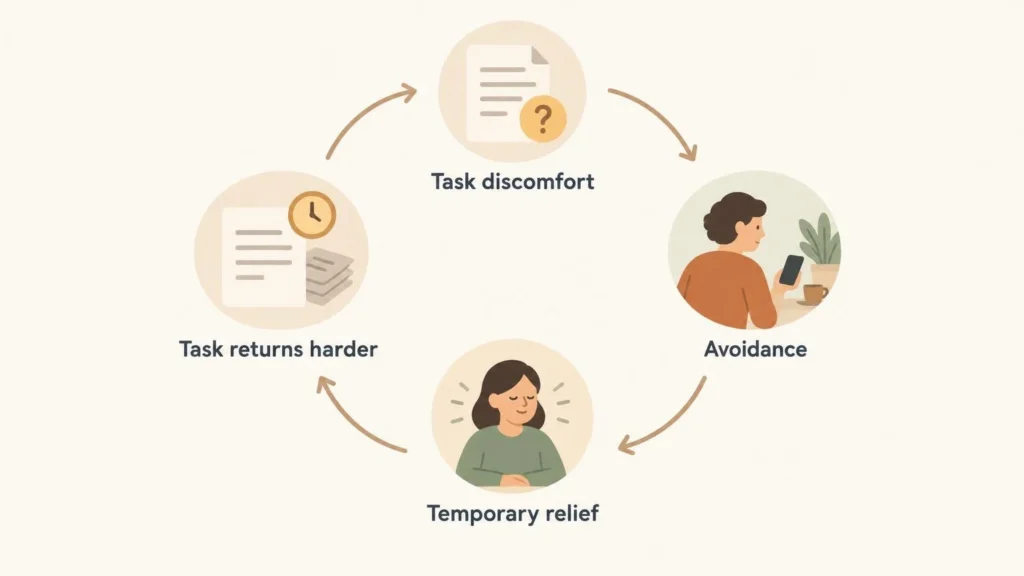
Discomfort, avoidance, and temporary relief
A task does not have to be especially difficult to feel uncomfortable. You might be unsure what someone expects, frustrated by tedious details, or worried about making a mistake. You might simply prefer almost anything else to the work in front of you.
Switching away can change how the moment feels. Checking messages, tidying your desk, or completing an easier assignment gives you something else to focus on. The uncomfortable task is no longer demanding your immediate attention.
That temporary relief can make postponing it feel like a reasonable choice. You have not necessarily decided never to do the task. You have decided not to face it right now.
The task comes back—and may feel harder to approach
The difficulty is that relief and resolution are different things. Unless circumstances change, the task may still need attention when you return.
By then, you might have less time available. You may need to reread instructions, remember where you left off, or decide how to handle a missed deadline. Several small unfinished tasks can also start to feel like one large backlog.
None of this happens with every delay. Sometimes waiting is sensible, and sometimes a task becomes easier once more information arrives. But when postponement adds difficulty without resolving the original obstacle, it can become part of a repeating cycle.
A familiar example, not a universal rule
Imagine receiving a work email asking for an update, but you are unsure how much detail to include. You open a simpler message instead. For a while, you no longer have to make that decision.
The next day, the original email is still unanswered. Now you are deciding both what to say and whether to acknowledge the delay. You switch away again.
Here, uncertainty led to avoidance, avoidance eased the moment, and the unresolved email became harder to approach. Your own pattern may look different. The useful question is whether this sequence helps explain a particular task—not whether it explains every delay.
WHAT MIGHT MAKE A TASK HARD TO START?
Before choosing a strategy, consider what you are actually trying to get past. “I keep procrastinating” describes the behavior, but it does not tell you what would make starting easier.
A vague task may hide several unanswered questions. “Prepare for the meeting” sounds like an instruction, but what does it require? Reviewing notes, creating slides, checking figures, or deciding what to say? If the first action is unclear, even a short task can be difficult to enter.
Size creates another obstacle. “Organize the house” or “plan my career” offers no obvious boundary. You may see the entire undertaking at once rather than a piece you could handle today. Even when the task matters to you, its scale can make a beginning feel inadequate.
Other tasks are clear but uninteresting. Sorting receipts may be straightforward, yet a conversation, a new message, or a more engaging assignment feels more appealing. In that situation, further planning may not be what you need; a smaller, bounded period of work may be more practical.
Concern about quality can also make the first step difficult. If you expect your first attempt to be polished, writing a rough paragraph may feel like doing the task badly rather than beginning it. Ask whether you are trying to create a finished result before you have allowed yourself a draft.
Then there are real constraints. Perhaps you need an answer from a colleague, lack access to a document, or have several responsibilities competing for the same hour. A task that cannot fit into your available time is not simply a test of willingness.
Treat these possibilities as questions, not labels. Is the obstacle uncertainty, scale, low interest, concern about mistakes, or something practical? More than one may apply. Identifying the specific difficulty gives you a better starting point than assuming you need to try harder.
NOTICE THE PATTERN WITHOUT TURNING IT INTO A VERDICT
There is a difference between describing what happened and deciding what it says about you. “I closed the form when it asked for information I didn’t have” is an observation. “I’m hopeless with paperwork” is a verdict.
The observation gives you something to work with. The verdict leaves the practical problem unexplained.
When you notice a delay, try a brief reflection. A few words in a note are enough:
- What task was I trying to do? Name the specific task rather than a broad category such as “everything.”
- When did I hesitate or switch away? Look for the point where progress stopped.
- What thought, feeling, or practical obstacle was present? Note uncertainty, boredom, a missing document, or whatever you noticed.
- What did I do instead? Record it neutrally, whether you checked your phone or handled another responsibility.
- What happened afterward? Did you feel relief? Did the task remain unchanged, become more urgent, or turn out not to matter?
Suppose you keep postponing a form. Looking at the moment of hesitation, you realize you do not know which income information it requires. Your next step may be to read the instructions or ask the organization a question. Criticizing your ability to manage paperwork would not answer that question.
You do not need to analyze every delay or keep a detailed record. If this exercise starts to feel like another assignment, simplify it to one question: What made the next step difficult?
The purpose is to find one useful adjustment. You can try that adjustment even if you do not fully understand the pattern yet.
MAKE THE NEXT STEP EASIER TO ENTER
Once you have some idea of the obstacle, choose an approach that addresses it. You do not need to use every strategy below. A single change—making the action clearer, gathering one missing item, or setting a stopping point—may be enough to make another attempt worthwhile.
Turn the task into one visible action
“Work on the report” names an intention, not a clear action. Before you can begin, you still have to decide what working on it means.
Try replacing it with something observable: “Open the report document and list the information I need.” You will know when you have done it, and you do not have to solve the whole assignment to begin.
A useful test is whether someone could tell what you were doing. “Get organized” is hard to observe. “Put the unopened letters in one tray” is specific. If your proposed action still contains several decisions, narrow it until the first move is clear.
Choose a deliberately small starting point
A clear action can still be too demanding for the time or energy you have. Choose a limited piece: write one rough sentence, gather one document, or review one section.
For example, “sort out my finances” could become “download last month’s statement for my main account and save it in a folder.” That action will not resolve every financial question. It does create a defined beginning without requiring you to address everything at once.
Starting small is not a promise that momentum will follow. You may finish that piece and stop. The point is to choose an honest, manageable commitment—not disguise a large work session as a tiny task.
Prepare the space and materials
Sometimes the obstacle is the number of things you must do before the actual work can begin. You need to locate a file, find a password, clear a surface, or retrieve a document from another room.
Remove one of those barriers. Open the relevant file, put the form beside the information it requires, or leave the necessary materials together for your next available work period.
You can also reduce one avoidable distraction, if practical: silence nonessential notifications or close an unrelated tab. You do not need ideal conditions or an empty calendar. Aim for one fewer interruption or one fewer preparation step.
Set a short, low-pressure start period
If beginning feels like agreeing to an exhausting session, give the attempt a boundary. You might choose five or ten minutes to look at the task, with permission to stop and reassess when the time ends.
Decide beforehand what you will do during that period. “Spend five minutes identifying the documents this application requires” is clearer than “try to be productive.” Keep the commitment focused on engaging with the task, not finishing it.
When the period ends, check what you learned. You might continue, choose a later work period, or discover that you need help. Stopping at the agreed time is not a failure to build momentum; it is one of the options you allowed yourself.
Clarify what “done for now” means
A task can feel difficult to enter when there is no clear point at which you are allowed to leave it. Define a useful checkpoint before you start.
“Done for now” might mean drafting the opening paragraph, reviewing one page, or sending one question. It should represent a meaningful piece of progress, not a demand to finish the entire project immediately.
When possible, leave a short note about what comes next. “Next: check the figures in the second table” gives your future self a place to return. “You might try this when you only have scattered pockets of time.
Ask for clarity or support when the obstacle is outside your control
Some tasks cannot move forward through effort alone. If instructions are unclear or another person’s input is missing, identify the specific question that needs an answer.
Instead of sending a general request for help, you might ask which sections of a form apply to you, whether a report needs recommendations, or when a colleague can provide the missing figures. A focused question makes the unresolved part easier to discuss.
If you must wait, note what is blocked and whether another portion can proceed. Where appropriate, tell the relevant person how the missing information affects timing. Asking for clarification or renegotiating a deadline can be responsible task management—not a failure to manage on your own.
IF YOU DELAY AGAIN, ADJUST THE PLAN
You may choose a small step, set aside time, and still not begin. Rather than treating that as proof that nothing works, look at what happened during this attempt.
Was the step still too large? Did you reach another unanswered question? Did an urgent responsibility take the available time? Was the planned work period unrealistic?
Use the answer to change something specific. Reduce the action, move it to a more workable time, ask for missing information, or discuss the deadline. If you planned to review an entire application but stopped at the first unfamiliar requirement, the next action could be writing down that requirement and finding out what it means.
Resist turning the restart into punishment. Requiring yourself to complete everything tonight because you missed yesterday may create a commitment that does not fit your circumstances. Return to a useful step rather than trying to repay the delay with an oversized work session.
This does not mean ignoring consequences. You may need to acknowledge a missed deadline, update someone, or revise a commitment. Those are concrete actions; self-criticism is not a substitute for them.
Persistent or widespread difficulty managing tasks can have many possible contributors. If it is disrupting daily life, or you would value help understanding it, consider support from an appropriate qualified professional or trusted resource. You do not have to solve every difficulty through a productivity technique.
START WITH ONE SMALL, CLEAR STEP
The discomfort–avoidance–temporary relief–renewed difficulty sequence is one possible way to understand repeated delay. It is not a diagnosis, a character judgment, or a rule that explains every unfinished task.
Its value is practical: noticing where you pull away can help you decide what to change. Perhaps the task needs a clearer instruction, a smaller first action, a realistic stopping point, or someone else’s input.
Choose one task you have been postponing. Write down the smallest visible action that would move it forward—not the whole plan, just the next move. Then ask whether you have what you need to attempt it. If not, make getting that information or support your next step.

