HOW CAN PERSONAL DEVELOPMENT IMPROVE YOUR LIFE? A PRACTICAL GUIDE
You may know that you want something to change without knowing exactly where to begin. Perhaps your days feel crowded but not especially satisfying. You keep postponing something that matters, or you want to handle everyday challenges with more clarity. Then you encounter advice to change your habits, set bigger goals, improve your mindset, and redesign your routine—all at once.
Personal development does not have to mean a complete life overhaul. It can mean choosing one meaningful change and finding a realistic way to explore it. You do not need to become someone else, make every hour productive, or treat yourself as a problem to solve.
This guide will help you understand what personal development can involve, where it might be useful, and how to begin without adding unnecessary pressure. The approach is straightforward: notice what matters to you, choose one area, try a manageable action, and review what you learn.
PERSONAL DEVELOPMENT STARTS WITH INTENTIONAL, MEANINGFUL CHANGE
Personal development is the practice of learning, reflecting, and taking intentional action toward something you want to improve. That might involve building a useful skill, reconsidering your priorities, communicating a need more clearly, or adjusting a routine that no longer fits your life.
The word intentional matters. Change happens whether you plan for it or not, but personal development invites you to participate more deliberately. Instead of automatically continuing a pattern, you ask: Is this working for me? What would I like to try differently?
This is different from constant self-optimization—the idea that every part of your life needs to become more efficient, impressive, or productive. A worthwhile change might actually involve doing less: reducing an unnecessary commitment, protecting time for rest, or letting go of a goal you no longer value.
It is also different from self-criticism. You can acknowledge that something needs attention without deciding that you are inadequate. “I want to practice speaking more clearly” gives you something to work on. “I am terrible at everything” gives you a judgment, not a direction.
The right direction depends on your circumstances and values. Personal development may help you make more deliberate choices, but it cannot guarantee happiness, success, or a problem-free life. Its value lies in giving you ways to engage with what you can influence—not in promising control over everything.
DIFFERENT AREAS OF LIFE CAN OFFER DIFFERENT STARTING POINTS
Personal development is broad, which can be useful and overwhelming in equal measure. The areas below are possible starting points, not a checklist you need to complete. You can choose the one that feels most relevant now and leave the others alone.
Changes in one area may also affect another. A clearer work routine might make room for learning; more direct communication might clarify how you spend your time. Those connections are possibilities, not guaranteed outcomes.
GOALS, HABITS, AND USE OF TIME
A clearer goal can help you decide what deserves attention. Without that clarity, an important task may remain on your mental list indefinitely, competing with whatever feels most urgent that day.
Personal development in this area might involve setting aside a brief, regular opening for something you keep postponing. It could also mean reviewing your commitments and deciding what to stop doing. Time management is not only about fitting more in; it can be about making more deliberate trade-offs.
A routine gives an action a place in your day, but it is a tool rather than a guarantee. Your available time, caring responsibilities, workload, and energy all matter. A useful plan respects those conditions instead of assuming you have unlimited flexibility.
SKILLS, LEARNING, AND WORK OR LIFE SATISFACTION
Building a skill can give you something practical to apply, while exploring your interests can help you understand what feels meaningful. You might practice writing, learn to use a tool, become more comfortable presenting ideas, or investigate a subject you have been curious about.
This does not require changing careers, enrolling in an expensive course, or making a major commitment. Development can begin with a focused practice activity, an introductory resource, or a conversation about what a particular role involves.
Reflection matters here, too. If work or another part of life feels unsatisfying, try separating the different issues. Is the difficulty about the tasks, the environment, the expectations, or a lack of opportunity to learn? A more precise understanding can help you choose a relevant next step, even when larger changes are not currently possible.
COMMUNICATION, RELATIONSHIPS, AND EMOTIONAL AWARENESS
Personal development can include noticing your reactions, listening more carefully, and expressing needs more clearly. Emotional awareness simply means paying attention to what you are feeling and considering how that feeling may be influencing your response.
You might pause before answering a difficult message, ask a clarifying question rather than assume someone’s intention, or explain a limit without expecting the other person to guess it. These are practical skills to explore, not demands to remain calm or communicate perfectly at all times.
Your own actions are only part of a relationship. You cannot control another person’s behavior or make a difficult relationship healthy through effort alone. The aim is to become clearer about your contribution, your needs, and the choices available to you—not to accept responsibility for every interaction.
CHOOSE A CHANGE THAT MATTERS TO YOU
Before choosing a goal, pause long enough to identify what you actually want. Advice can make certain goals look universally desirable: earn more, wake earlier, read more, become more outgoing. But a goal can sound impressive and still be a poor fit for your life.
Start with everyday experience. What repeatedly frustrates you? What feels neglected? What would you like to have more room for? Look for a change that would matter even if nobody else noticed.
Use these questions to narrow your focus:
- What would I like to be different in everyday life?
- Why does this matter to me?
- Is this goal mine, or am I responding mainly to comparison or pressure?
- What part of this is within my influence right now?
- What constraints—such as time, responsibilities, resources, or health—should shape my plan?
You do not need perfect answers. A few honest notes may be enough to distinguish a meaningful aim from an expectation you have absorbed. Other people’s ideas can inspire you, but you still get to decide whether those ideas belong in your life.
Choose one area for now. Focus makes it easier to identify a first action and see what you learn from it. This is not a permanent commitment. You can revise, pause, or set aside a goal when your circumstances change or when experience shows that something else matters more.
TURN A BROAD INTENTION INTO A SMALL, PRACTICAL PLAN
A broad intention describes a direction. A practical action tells you what to do next. “Get organized” may express a genuine need, but it leaves many decisions unanswered. “Spend a short, planned period sorting one part of my workspace” gives you a clear place to begin.
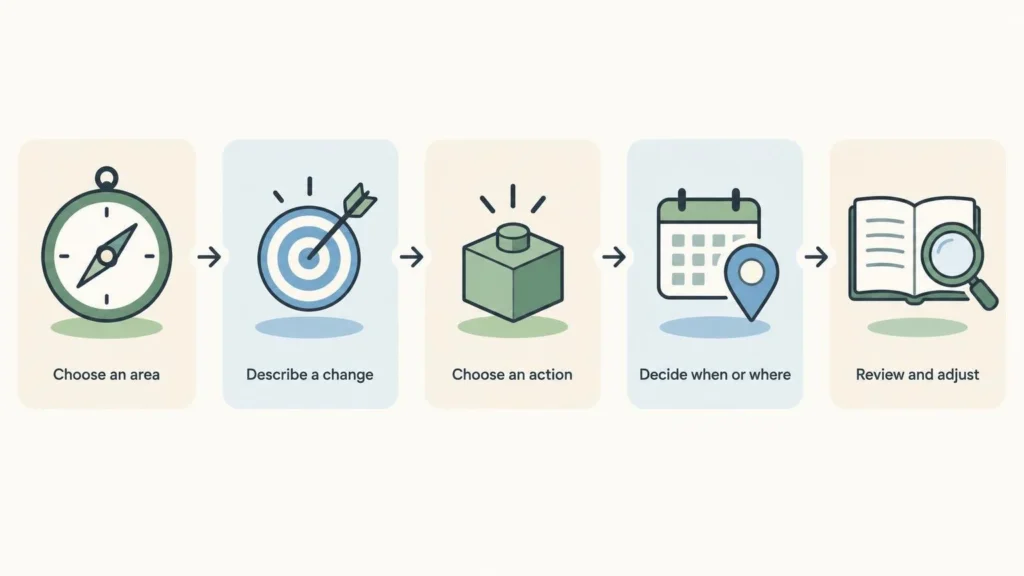
The purpose of a small plan is not to make your ambition smaller. It is to make your next move easier to understand and possible to attempt.
- Name the area that matters. Identify the part of life you want to work on and why it deserves attention.
- Describe a specific change to try. Translate the broad aim into something you could observe or do.
- Choose a small first action. Pick an action that fits your current time, resources, and responsibilities.
- Decide when or where to try it. Give the action a practical opening if that helps you remember it.
- Review before expanding. See what fits, what feels difficult, and what needs adjusting before adding more.
Try to choose an action you can directly take rather than an outcome you cannot fully control. You can prepare a question for a conversation; you cannot guarantee how the other person will respond. You can practice a skill; you cannot dictate when an opportunity will appear. Keeping that distinction clear makes the plan more honest and useful.
A HYPOTHETICAL EXAMPLE: MAKING MORE ROOM FOR LEARNING
Imagine someone who wants to learn basic spreadsheet skills but feels short on time. Their initial aim is “I should get better with technology.” That is too broad to guide a busy evening, so they clarify why the skill matters: they want to feel more capable handling a recurring task at work.
Rather than commit immediately to a large course, they choose one small practice activity: open a sample spreadsheet and try the function needed for that task. They place it in an opening that already exists in their schedule, such as a quiet period after lunch on a less crowded workday, if their workplace allows it.
After trying it, they review the fit. Perhaps interruptions made that timing impractical. Perhaps the resource assumed knowledge they did not have. They could change the time, find a simpler explanation, or ask someone to demonstrate the task.
This hypothetical plan is not evidence that a particular method works for everyone. It illustrates how a vague wish can become a manageable experiment—and how the experiment can provide useful information even when the first attempt is awkward.
MAKE PROGRESS EASIER TO RETURN TO
Once you have a practical action, consider what would make returning to it less cumbersome. You might use a reminder, prepare materials in advance, or connect the action to an existing part of your day. These supports reduce the number of decisions you need to make at the moment you intend to begin.
Choose supports that suit your environment. A calendar alert is useful only if you can reasonably act on it. Preparing materials helps only if they can remain accessible. If a reminder repeatedly arrives at an impossible time, change it rather than treating every dismissal as a failure.
You can also define a modest version of the action for crowded days. In the learning example, that might mean reviewing one instruction instead of completing a full practice activity. The smaller version should still serve the goal; it does not need to exist merely to preserve a streak.
Sometimes the appropriate choice is rest or a pause. A sustainable approach leaves room for illness, demanding weeks, family responsibilities, and financial pressures. It should not turn every difficult day into another test you must pass.
When circumstances shift, revisit the plan. Ask whether it still fits your available resources and whether the goal still deserves the same priority. Adapting your approach is part of intentional action, not a departure from it.
REVIEW WHAT IS WORKING—AND WHAT NEEDS TO CHANGE
Progress is easier to assess when you occasionally step back, but constant evaluation can become another obligation. Choose a low-pressure review point that suits the activity—perhaps after several attempts or at a natural break in your schedule.
A short note can be enough. The aim is to understand your experience, not to produce a detailed report on yourself.
- What did I try?
- What did I learn about what fits or does not fit?
- Did I take any steps, even if the larger result is not here yet?
- What obstacle or support should I account for next?
- Should I continue, adjust, pause, or choose a different focus?
Look at outcomes, but also notice effort and learning. Preparing for a conversation does not guarantee agreement, yet you may have expressed your needs more clearly. Trying a learning activity may reveal that you need a different resource. Those observations can inform your next decision.
At the same time, effort alone does not make every plan worthwhile. If you keep taking action without moving toward something that matters, consider whether the approach—or the goal—needs changing. An honest review allows both recognition and revision.
A missed action or slow result is information about what happened. It is not, by itself, proof of personal failure.
WHEN A PLAN STALLS, RESPOND WITH CURIOSITY INSTEAD OF SELF-CRITICISM
If your plan stalls, start by identifying the practical obstacle. Was the action too ambitious? Was it unclear? Did you forget, lack the necessary materials, or run out of available time? Did circumstances change after you made the plan?
Different obstacles call for different responses. An unclear action needs clarification, not more pressure. An unrealistic schedule needs adjustment, not a stronger promise. A resource problem may require practical support or a different route.
Make one relevant adjustment where possible. You might reduce the next action, move it to another setting, ask for help, or revise the goal. Changing everything at once can make it harder to understand which part of the plan needed attention.
Not every barrier can be solved through individual effort. Limited money, inaccessible opportunities, heavy responsibilities, health concerns, and other external conditions can constrain your options. Recognizing those limits is not making excuses; it is describing the situation accurately enough to plan responsibly.
You do not have to celebrate a setback or pretend it was necessary. You can be disappointed and still respond constructively: What happened, what is possible now, and what would be a reasonable next decision?
SELF-HELP HAS LIMITS—SUPPORT CAN BE PART OF THE PLAN
Reflection, goal-setting, and everyday skill practice have limits. They are not substitutes for qualified help with serious, persistent, or difficult-to-manage concerns. A challenge that affects your wellbeing may need more than a new routine or a different perspective.
If you are worried about your wellbeing or your ability to manage a concern, consider contacting an appropriate qualified professional. A trusted support person may also help you talk through what is happening or take the first step toward getting suitable assistance.
Practical support can belong in ordinary development goals as well. You might ask someone to explain a task, discuss expectations, or help you identify available options. You do not need to handle every part of growth alone.
Seeking support does not cancel your agency. It can be a deliberate decision about what the situation requires. Personal development is most useful when it helps you recognize both what you can do yourself and when a self-guided approach is not enough.
START WITH ONE NEXT STEP, THEN LEARN FROM IT
Personal development can be a flexible practice of noticing what matters, taking intentional action, and adjusting as you learn. You do not need a complete plan for your life before beginning, and you do not need to improve every area at once.
Choose one meaningful focus. Write down a small action you can realistically try, give it a suitable opening, and decide when you will review the experience. Let what happens inform your next step rather than judge your worth.
What is one change that would make everyday life feel a little more aligned with what matters to you—and what is the smallest useful step you can take next?