
You know which task needs your attention. You have thought about it, added it to your list, and perhaps reminded yourself several times that it matters. Yet when there is a chance to begin, you find yourself doing something else—or staring at the task without knowing where to enter it.
That gap between intention and action does not, by itself, mean you are lazy or incapable. “Prepare the report” may be clear as a responsibility but unclear as an instruction. The work may also feel too large for the time, energy, or space you have available.
Rather than demanding more determination from yourself, try making the start more specific. Choose one task, identify a visible first action, remove one avoidable obstacle, and give the first session a manageable boundary.
The goal is not to finish everything or make all reluctance disappear. It is to turn something you keep meaning to do into something you can attempt under today’s conditions.
CHOOSE ONE TASK, NOT YOUR WHOLE TO-DO LIST
Before you can begin, you need to decide what you are beginning. But comparing every unfinished obligation can become another task that keeps you from the work itself.
You do not need a complete ranking of your responsibilities. You need a reasonable choice for this session. Use one criterion: an approaching deadline, the importance of the outcome, or the usefulness of making a little progress today.
Those criteria may point to different tasks. That is fine. The aim is not to prove that your selection is perfect. It is to choose something worth doing without spending your available time deciding.
Make a quick, good-enough choice
Suppose you need to prepare a work report, book an appointment, sort some paperwork, and reply to a nonurgent message. The report is due soon, so you select it based on the deadline. You have not decided that the other tasks are unimportant. You have simply chosen what receives this piece of your attention.
If two tasks seem equally important, consider which has a first action you can take with the resources available. Perhaps you cannot book the appointment until the office opens, but you can begin the report now.
Keep urgent commitments in view, but do not require yourself to settle the entire week before using the next few minutes. Write down the task you choose. If other obligations keep coming to mind, note them separately rather than switching between them.
TURN THE TASK INTO A VISIBLE FIRST ACTION
A task describes something you want completed. A first action describes what you will actually do next. That distinction matters when an item on your list leaves you facing several decisions at once.
“Prepare the report” might involve finding instructions, gathering figures, choosing a structure, drafting, and checking the finished document. It names the destination, not the next move.
A useful first action begins with a clear verb and names an object or a small result: open the document, find the instructions, write a heading. Ask yourself: Could I tell, just by observing what I did, whether this action happened?
“Think about the report” is difficult to define. “Write one sentence describing what the report needs to explain” produces something visible. It does not need to be polished to count.
Replace vague steps with concrete ones
Try translating broad intentions into instructions you can follow:
- “Get organized” becomes “Put the papers needed for the appointment on the table.”
- “Deal with the form” becomes “Find the form and read the first question.”
- “Work on the report” becomes “Open the document and write three rough headings.”
These are examples, not rules. If you already have the form open, finding it adds nothing. If the report has a required structure, reading that structure may be more useful than inventing headings. Choose an action that matches the task’s current state and what you can do now.
Also check whether your proposed first step conceals several others. “Gather all the information” may still be a substantial assignment. “Find last month’s sales file” gives you a clearer place to begin.
If you do not know what comes next
Sometimes the next action is to resolve one uncertainty. You might locate the instructions, check what documents are required, or write a specific question for someone who can clarify the request.
For the report, that could mean finding the original assignment email. If it does not explain which period to cover, your next action could be sending a question about the reporting dates.
You do not have to map the entire project first. Find enough information to identify the next useful move.
LOWER ONE BARRIER BEFORE YOU BEGIN
Once you have named the action, look at what stands directly between you and doing it. Not every difficulty can be removed, but one practical adjustment may make the action more accessible.
Ask: What would I have to deal with before I could carry out this step? Perhaps the file is buried in a folder, the needed papers are in another room, or your available workspace is covered. Address the obstacle closest to the action rather than redesigning your whole environment.
Make the first move easier to reach
If your action is to write three report headings, open the correct document and place the assignment instructions beside it. If your action is to complete the first line of a form, put the form and a pen within reach. If you need to make a call, find the number and any details you will be asked to provide.
Make each adjustment serve the chosen action. Clearing enough space for your notebook is preparation; deciding to reorganize the entire desk may become a separate project. Moving a distracting item out of reach is an option; creating a perfectly distraction-free room is not a requirement.
You may have little control over your setting. A shared workspace, caregiving responsibilities, or an unpredictable schedule can limit what is possible. Work with the adjustment you can make: keep one relevant tab open, collect the materials in a folder, or choose an available seat where you can use them.
The test is simple: does this preparation bring you closer to the action you named? If it does not, leave it for another time.
SET A SMALL BOUNDARY FOR THE FIRST SESSION
“I will start the report” can sound like a commitment to keep working until it is finished. Give the session an explicit endpoint instead. You are agreeing to a limited attempt, not signing over the rest of your day.
You can define that boundary by time or by a small piece of work. For example, you might work for ten minutes if that fits your schedule. Or you might stop after writing three rough headings, regardless of whether they need revision later.
Neither approach is automatically better. A time limit may suit an exploratory task whose scope is unclear. A concrete stopping point may suit work with a small, identifiable piece you can complete. Choose the boundary that makes sense for your circumstances today; no particular duration is a requirement.
Decide what “enough for now” means
Before beginning, complete this sentence: “This session ends when…” Keep the answer clear enough that you will recognize the endpoint. “When I have made good progress” is open to interpretation. “When I have written the three section headings” is not.
Make the standard fit the purpose of a first attempt. Rough headings can be enough; polished headings may not be necessary yet. If you choose a time boundary, reaching it completes the session even if the task takes longer than expected.
You can continue afterward if you want to and your circumstances allow it. But continuation is a new decision, not a hidden condition attached to starting.
USE A SIMPLE START SEQUENCE
You can bring these choices together without creating an elaborate plan. Try this short sequence when you need to turn a known task into an initial session:
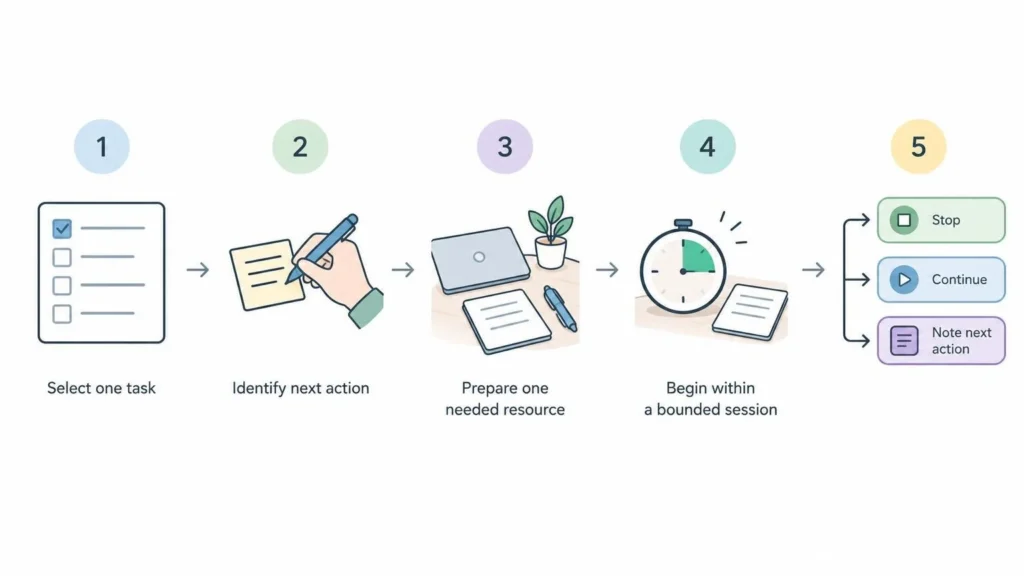
- Choose one task. Use a practical criterion, such as its deadline or importance.
- Write the next physical action. Name something observable that you can attempt now.
- Make one needed item or resource ready. Remove the obstacle immediately in front of that action.
- Begin within your chosen boundary. Work for the time or small stopping point you set.
- Reassess at the end. Stop, continue, or record the next action.
Use this fill-in prompt to make the starting point explicit:
“The task is ____. The next physical action is ____. I’ll begin by ____.”
For the running example: “The task is preparing the work report. The next physical action is writing three rough headings in the report document. I’ll begin by opening the document and placing the assignment email beside it.”
Then add a boundary: “I will stop after those headings and decide what comes next.”
The prompt is not another assignment to perfect. A rough sentence is enough if it tells you what to do. Once the action and boundary are clear, carry out the first move rather than continuing to refine the plan.
IF STARTING STILL FEELS DIFFICULT, ADJUST THE NEXT MOVE
A clear plan does not guarantee that starting will feel comfortable. You may still feel reluctant, encounter a practical obstacle, or discover that your first step was not as manageable as it sounded.
Treat that as information about the plan. You can revise the action without judging yourself or rebuilding the whole process.
The action still feels too big
Look for several actions bundled into one. “Draft the report” includes deciding what to say and producing multiple sections. “Write three headings” is smaller, but even that may require choices you are not ready to make.
Reduce it again: copy one required heading from the assignment brief, or write one rough note about the report’s main question. The smaller action should still connect to the task. You are looking for a useful entry point, not a substitute activity that leaves the work untouched.
If polished wording is holding you up, allow a clearly marked placeholder. A note such as “Add explanation of monthly change here” can identify what belongs in a section without pretending the explanation is finished.
You are waiting on information or someone else
Separate what is genuinely blocked from what remains possible. If you need a colleague’s figures, you may be unable to complete the results section. You might still prepare the headings or list the figures you need.
When asking for information, make the request specific enough to answer. Instead of asking for “help with the report,” identify the missing item or decision. If nothing else can usefully proceed, record the dependency and what you will do after the reply arrives. There is no need to manufacture busywork to count the session as worthwhile.
You have very little time or may be interrupted
Choose a stopping point that fits the available window. Finding the required file or writing one question may be more realistic than beginning a draft you cannot leave easily.
If you have to step away, leave a brief return note: “Next: add one note under Results. Figures are in the shared monthly folder.” That gives you a place to resume without reconstructing every decision.
Some windows will be too short or too disrupted for useful work. In that case, note the next action and leave it ready for a more workable opportunity.
You have started but are unsure whether to continue
At the planned boundary, check your available time and other commitments—not just whether the task is finished. You can stop as agreed, choose another small piece, or continue for a new defined period.
Stopping does not cancel the work you did. The first session was a bounded attempt, and you are allowed to honor that boundary.
END THE SESSION WITH A CLEAR NEXT STEP
Before closing the document or putting the materials away, leave yourself a short record of where things stand. Note what you completed, what remains unresolved, and the next physical action.
For the report, that might be: “Three headings drafted. Need figures for the Results section. Next: add one rough note under Background using the assignment email.”
This is not a performance review. You do not need to rate your focus, justify your pace, or write a detailed account of the session. The purpose is to preserve useful information for your return.
If you made less progress than expected, record the obstacle plainly: “Could not access the folder; next action is to request access.” That gives you a more useful starting point than “Try harder tomorrow.”
Where possible, leave the relevant materials easy to locate. A clear note and an accessible file can make the next attempt less dependent on remembering what you had planned.
MAKE THE FIRST MOVE SMALL ENOUGH TO TRY
You do not have to solve the whole task in your head before beginning. Choose one responsibility, name a visible action, and give yourself a workable boundary for attempting it.
The action may be modest. It may not remove your reluctance. It only needs to provide a concrete way into the work.
Choose one task now and complete the prompt: “The task is ____. The next physical action is ____. I’ll begin by ____.” Then decide what will count as enough for this first session—and attempt that first move.